Models by Ted Kanas (1)
(This gallery has got a bit too large for one page, so I've split it, with older entries to be found here.)

Ted's gorgeous 4mm Castle 4082 "Windsor Castle" built for a friend overseas. Primarily it's from a Malcolm Mitchell kit with a Martin Finney 4000g tender. Powered by a Portescap motor/gearbox and running on Romford driving wheels with Ultrascale bogie and tender wheels.

The GWR crane was constructed from a D&S kit with a scratch-built cab and fittings, the match truck was entirely scratch built. The tool van was constructed from a WEP Models kit but with modified springs and running gear from JLTRT and the 1-plank wagon from a Cooper-Craft (now Slaters) kit. The crane is a Cowans & Sheldon of which the GWR had several. Strictly speaking it is unlikely this tool van would have been utilized with this crane as the former was a Stafford Road all its life and was a one-off diagram and the later was I think at Laira, but I adopted a bit of modeller's licence.


GWR 111 "The Great Bear", built from the now long unobtainable Oakville Kit but with a fair degree of parts from other manufactures, predominantly JLTRT and scratch built. Slaters wheels and a Ron Chaplain motor and gear box. Finished in its last livery to portray its last few days in service before being rebuilt as a 4-6-0.


In its initial GWR livery, this 4mm King George V is built from a Malcolm Mitchell kit loco and Martin Finney tender. Driving wheels are Romfords, the other wheels are Ultrascale, and the loco is powered by a Portescap motor.

|
In post WWII livery, 5414 is a demo model of a JLTRT kit.

|
Saint David was the last Saint to survive, being withdrawin in October 1953, but Ted's model, built from a Slaters kit, depicts the loco in GWR days, with original buffers and a tall safety valve. The name and numberplates are from Severn Mill Nameplates. A small point on the livery: in GWR days, the power and route restriction disc would have still been high up on the cab sheet.

|
Ted's model of 2937 'Clevedon Court', in BR(W) mixed-traffic livery, running with a Collett 3500g tender. This was the penultimate Saint to have been withdrawn, in June 1953, its last shed being Hereford. The model is from a JLTRT kit utilizing a super detailing enhancement from them too, and powered by a Ron Chaplain motor & gearbox with a DCC chip, running on Slater's wheels. Spray painted with cellulose and lined with Fox transfers.

|
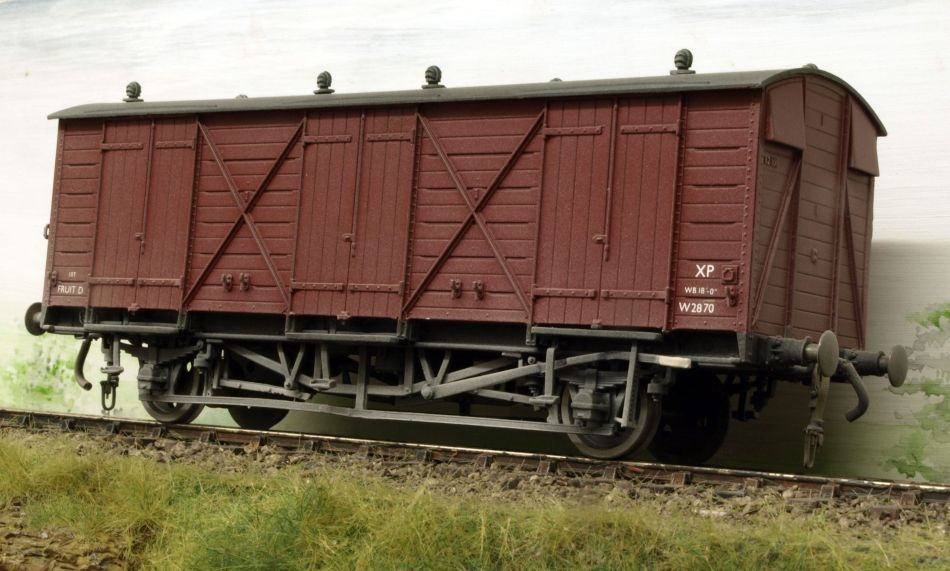
| Some weathered vans in BR livery. The Pythons A and B and the ASMO are all from Scorpio etched brass kits, and the S10 Bloater, Y11 Fruit D and V22 Mink G are from JLTRT resin kits. |
 |



|
7807 Compton Manor, in two guises, with a Churchward 'intermediate' 3500g tender with the early BR cycling lion totem when it was shedded at Chester (6E) c 1956 and in later life with a normal 3500g tender when it was at Oswestry (89A), with a later BR 'ferret on a dartboard' totem. The loco's smokebox shedplate is changed according to which tender is being run. The tender comparison picture shows the different body heights. Strictly speaking, the loco in its later guise should have a slimmer chimney, these being fitted when the smokebox draughting was improved.
The loco and tenders were built from Malcolm Mitchell/JLTRT kits with a substantial degree of additional super detailing, and run on Slaters wheels, apart from the intermediate tender, for which Ted used his last set of 7mm Ultrascale wheels. The loco is powered by a Ron Chaplain gearbox & motor with a digital chip – which Ted finds really improve its performance. Painting is with an Iwata airbrush using cellulose paints and lining is mainly Fox transfers with an addition HMRS Pressfix transfers.


|
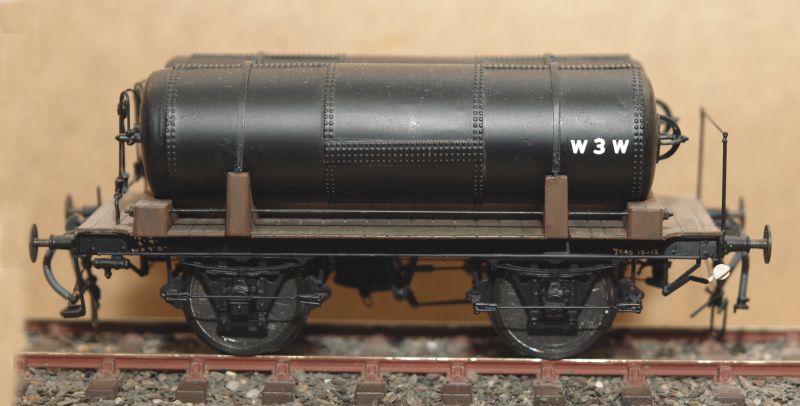
Two Cordon gas tank wagons, a diagram DD4 with the nine tranverse tanks and a diagram DD5 with two longitudinal gas tanks, the latter having outside clasp brakes. Both are made from WEP kits and finished in BR (WR) black, but yet to be weathered.
These wagons were deployed to larger stations to keep the tanks of gas-lit carriages topped up.
|

|
The GWR had its own tarmac laying and repair operation for road surfaces on its land and stations, and purchased four Aveling & Porter steam rollers for that purpose, transporting them around on four diagram F2 steam roller wagons. This is one such pairing from a PMK kit and a steam roller and its water cart, the latter being whitemetal Duncan Models kits. The wagon is painted black but on weathering it assumed a GWR freight grey colour; such is the unpredictability of weathering. They were scrapped soon after nationalisation so it's extremely unlikely they would have been repainted into BR colours.
 |
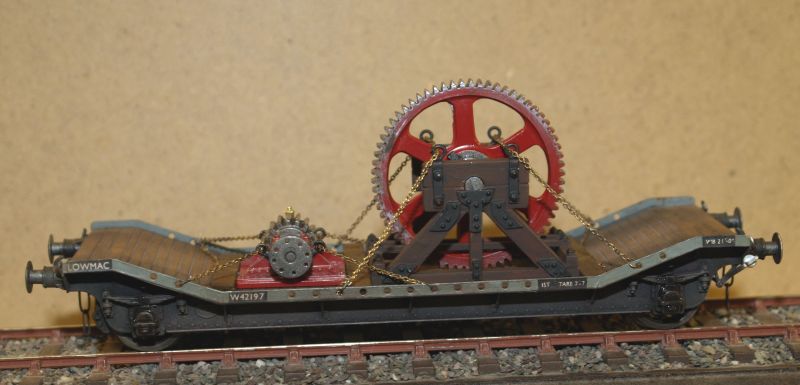
| Lastly, an ex-GWR Loriot M wagon diagram G14, from a Connoisseur kit, transporting a pair of machinery gear wheels also from Duncan Models white metal kits. |
|
|
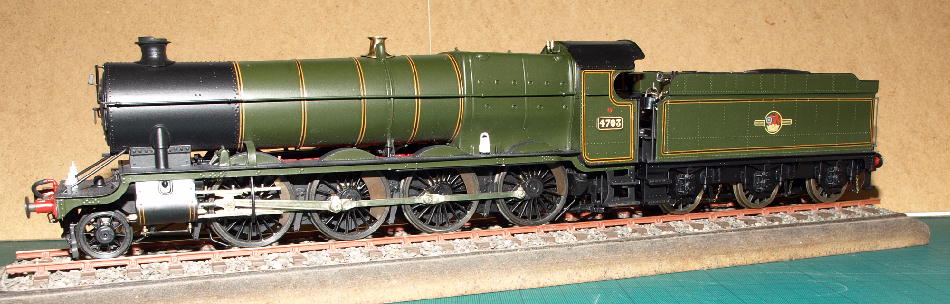
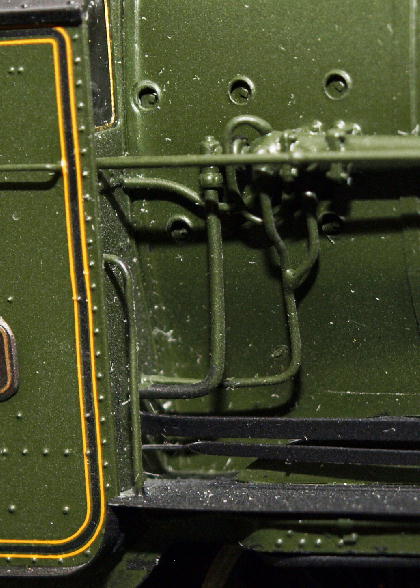
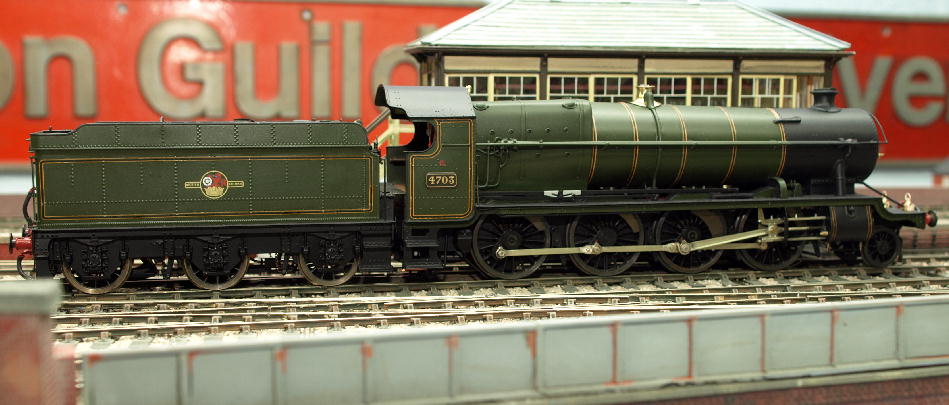
Ted's 4703, from a 7mm Martin Finney kit, apart from the buffers, which were sourced from JLTRT. It rides on Slaters' wheels on the loco and Ultrascale (7mm sadly no longer available) on the tender, and is powered by a Ron Chaplain gearbox & motor combination. It's also got a digital chip in, Ted deciding it was "high time I stepped into the 21st century".
The loco is in the post-1956 lined green livery – note no firebox lining, BR-style lining on the cylinders, and green valancing.
Although occasionally seen in daytime, these 'big Churchwards' were usually nightbirds, their principal work being the heavy fast fitted night-time freights.
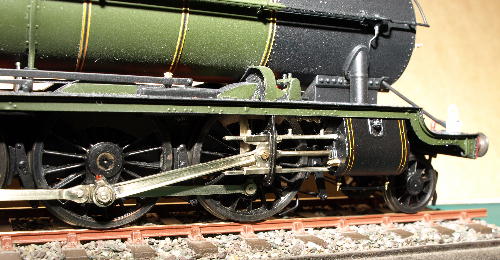
Below is 4703 pictured on Pete Waterman's Leamington Spa layout.
|
|
|
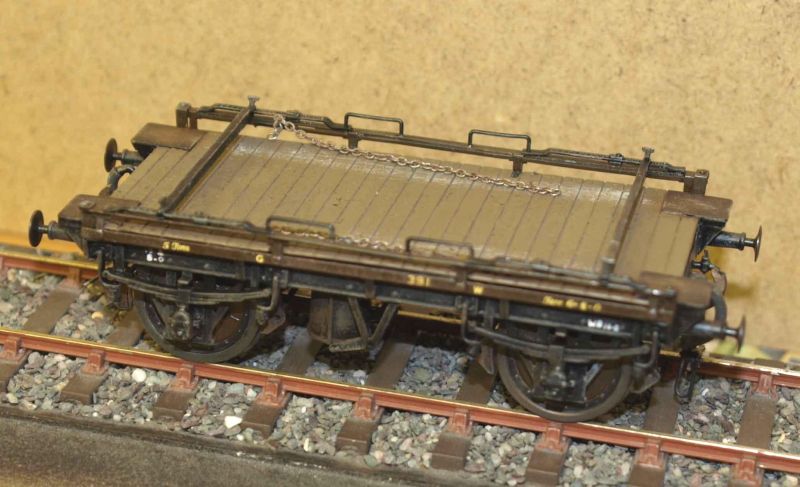
| Carriage truck, telegraph-code name 'Scorpion', built from a a D&S 7mm kit, in post-1922 brown livery. (If repainted during 1912-22, these vehicles would probably have carried crimson lake livery, being classified as 'Passenger stock'.)
|
|
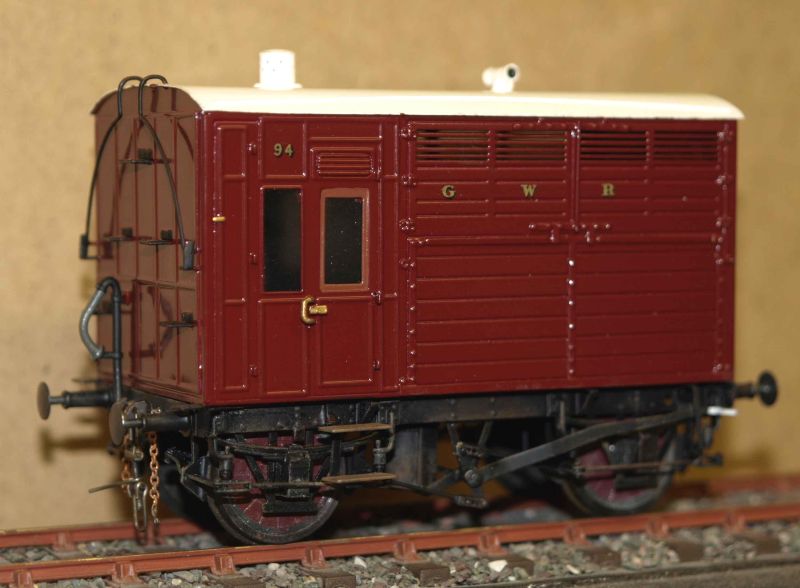
A diagram N4 horse box, built from a D&S 7mm kit. It is shown in pre-1904 brown livery, with small 'G W R' insignia, and safety chains still in place.
The 'foghorn' ventilator on the roof should be oriented at 90° to that shown in the picture, and it looks as though Ted has used some shaded 4mm scale insignia and numbering instead of prototypical unshaded ones for this era.
|
|
|
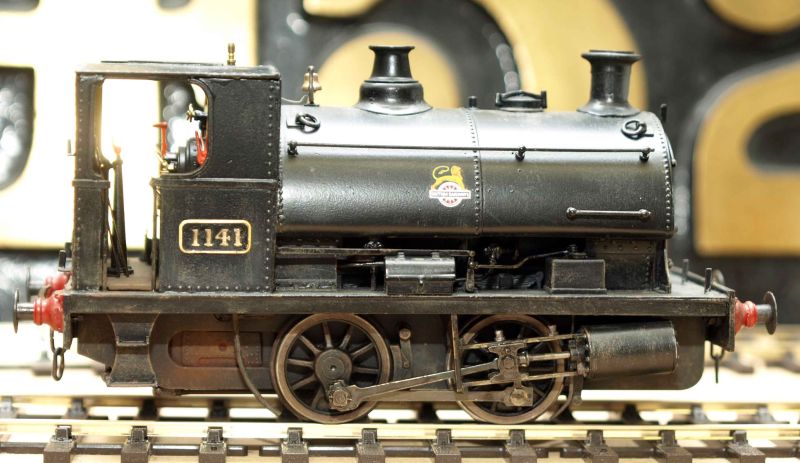
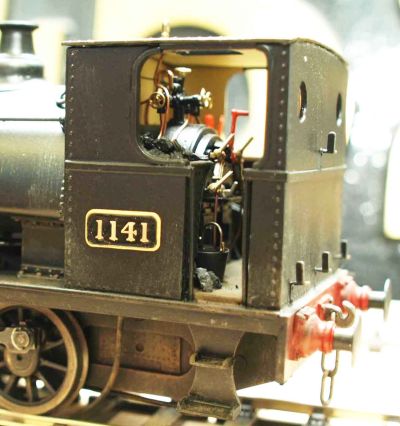
| Another 7mm Peckett tank, this one being built from an Eric Underhill kit, and finished in BR (WR) weathered black. It is powered by a Mashima motor and runs on Slaters' wheels. This was one of the Pecketts operated by the Swansea Harbour Trust. It's shown with its BR(W) running number, which superseded the the GWR running number of 929.
|
|

This 7mm ex-Cambrian 2-4-0T 1196 was constructed from an Agenoria kit and as with the majority of my 7mm Finescale kits runs on Slaters' wheels. This model has a split-axle sprung chassis, and is powered by an RG4 motor, the driving axle being modified to 1/8" to accommodate the motor.
|

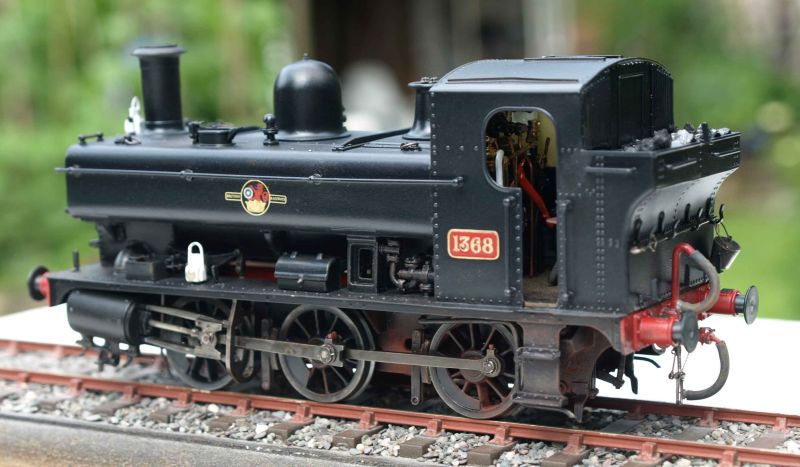

A brace of 7mm dock tanks. Below is 1365, one of the Churchward 0-6-0ST class introduced in 1910, built from a "Standard British Locomotive Kit" (sadly no longer available) and runs on a sprung chassis with Slaters wheels powered by a RG4 motor with axles turned down to 1/8" diameter to be able to accommodate it.
Above and right is 1366, the later Collett version with pannier tanks, and was constructed from a Zephyr Kit (ex Eric Underhill) and also runs on Slaters wheels powered by a RG4 motor. Coupling rods in this loco were from Premier Components as those supplied in the kit were too flimsy.
 |
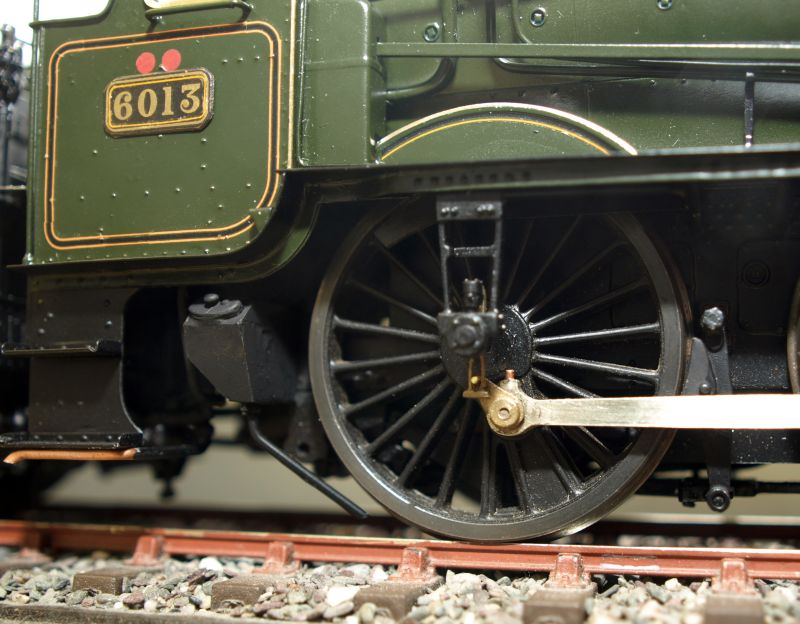
| Ted's superb 7mm model of 6013 "King Henry VIII", depicted in early 1950s condition with a 4-row lubricator cover and a single chimney (6013 being fitted with a double chimney in June 1956). The model was built from a Malcolm Mitchell/JLTRT kit also using the latter's super detailing kit for added realism. It runs on Slater's wheels and is powered by a Ron Chaplin motor and gearbox which gives it great running characteristics. Ted made the speedometer work as well as the outside cylinder valves and inside cylinder cross-heads. It was painted with cellulose paints and lined with Fox waterslide transfers.
|
|
Further Ted Kanas models can be found here.
|